


Elderberry: Why This Shrub Could Become Your Most Important Encounter During Your Wilderness Year
Free 35 Survival Hacks you'll love!
You will get 35 easy-to-implement survival hacks so that you don't have to stand aimlessly in the forest from tomorrow when things get tough. Take your skills to the next level!
DOWNLOAD HERE FOR FREE👉 The key facts from this guide
- The elder is more than just a berry bush—it is a fire-starter, instrument-maker, apothecary, and mythical household spirit all rolled into one.
- There are three species you need to know: Black Elder (edible after heating), Red Elder (remove the seeds!), and Dwarf Elder/Danewort (completely poisonous).
- The pith is a bushcraft treasure—serving as a fire-booster, a tinder substitute, and material for making pipes or blowguns.
- Elder indicates signs of human presence—wherever it grows, there was often once a homestead, a ruin, or a manure pile.
- "Tip your hat to the elder"—our ancestors knew exactly why this shrub deserves such special respect.
- Never eat the berries raw—sambunigrin causes illness. They are safe to consume after being heated to 80°C (176°F) for 20 minutes.
When I think of my childhood in the Thuringian Forest, there is one image that immediately comes to mind.
A huge elderberry bush behind my grandparents' garden. It was so large that we children had our own hideout underneath it. A small cave made of branches where we played for hours.
My grandmother harvested blossoms there every summer. And berries in late summer.
I still clearly remember the smell of the boiling elderberry juice in the kitchen. That deep violet color that stained everything. On the hands, the dishes, the wooden floor.
Years later, when I learned in my wilderness pedagogy training that the elder was considered the seat of Mother Hulda – the sacred tree of the grandmother goddess – something inside me quietly "clicked."
Of course it was.
My grandmother probably didn't know that consciously. But she treated it as if it were part of the family. No one would have cut it down. No one would have even pruned it back heavily. It just stood there. It belonged. It received its attention every year.
Today I know: That was no coincidence. That was heritage.
Three species – and you should know all three
Before we dive into the beautiful stories and bushcraft applications, we need to get factual for a moment.
Because elderberry isn't just elderberry.
There are three species in our latitudes – and anyone who confuses them has a problem.
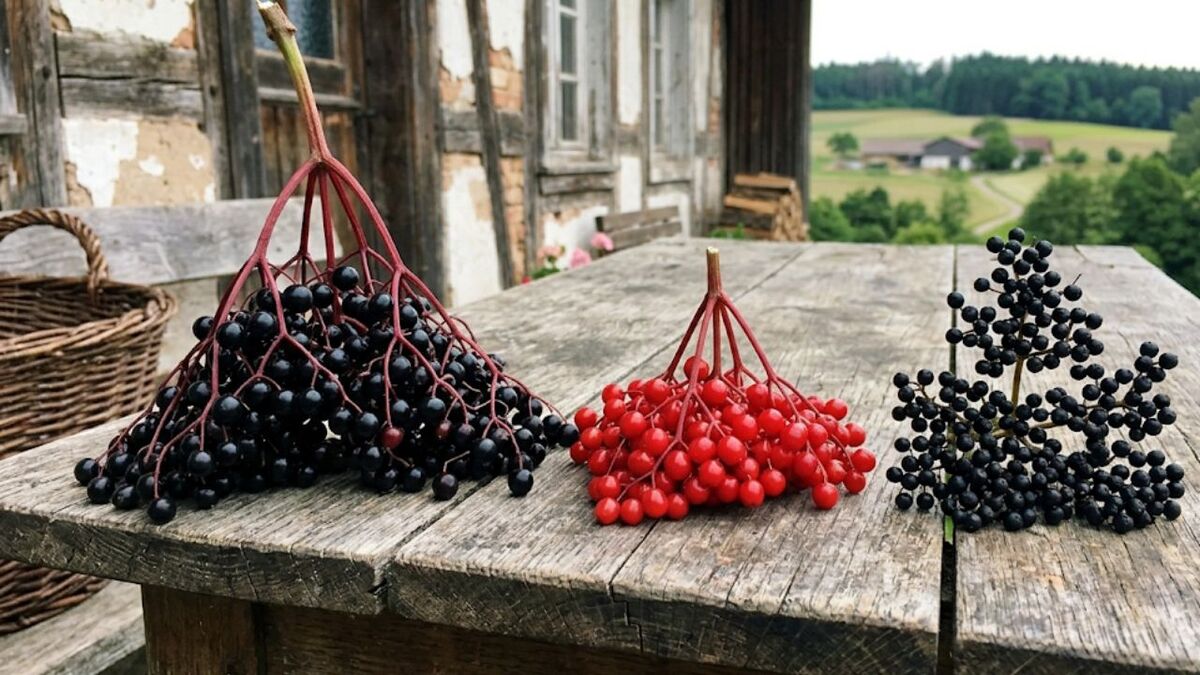
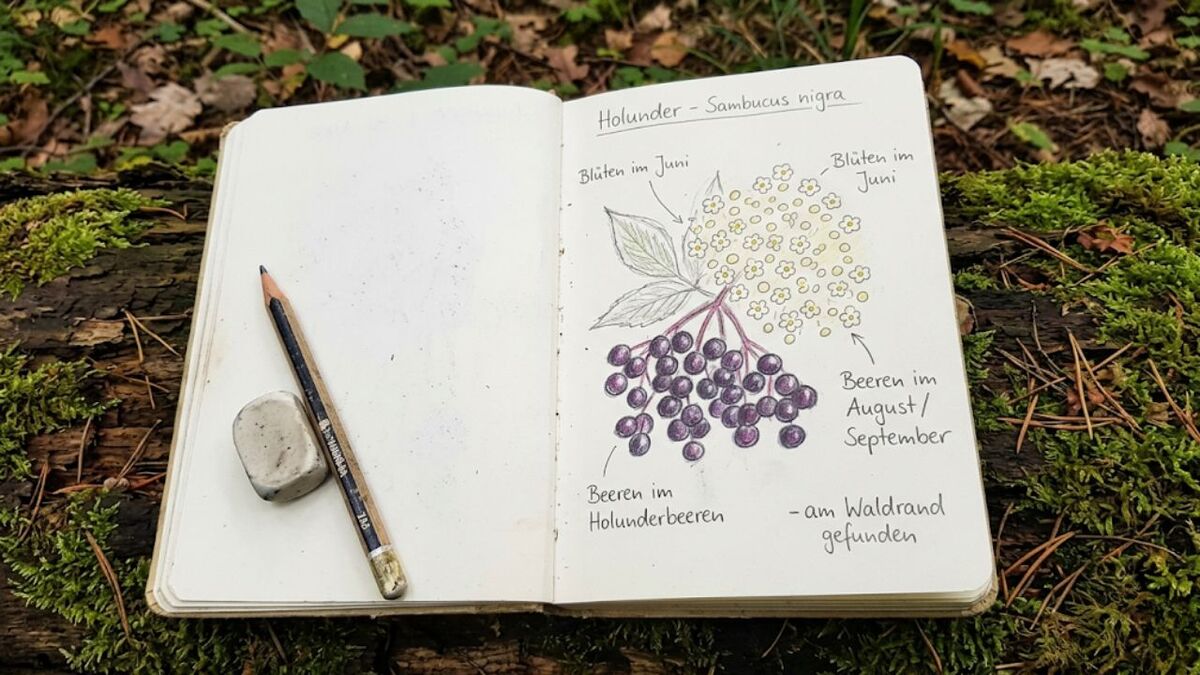
Black Elderberry (Sambucus nigra)
This is *our* elderberry. The one with the white flower umbels, black berries, and the characteristic white pith.
- Woody shrub or small tree up to 10 meters
- Plate-shaped, drooping flower panicles
- Black, shiny berries in drooping umbels
- Pith inside the branches: white
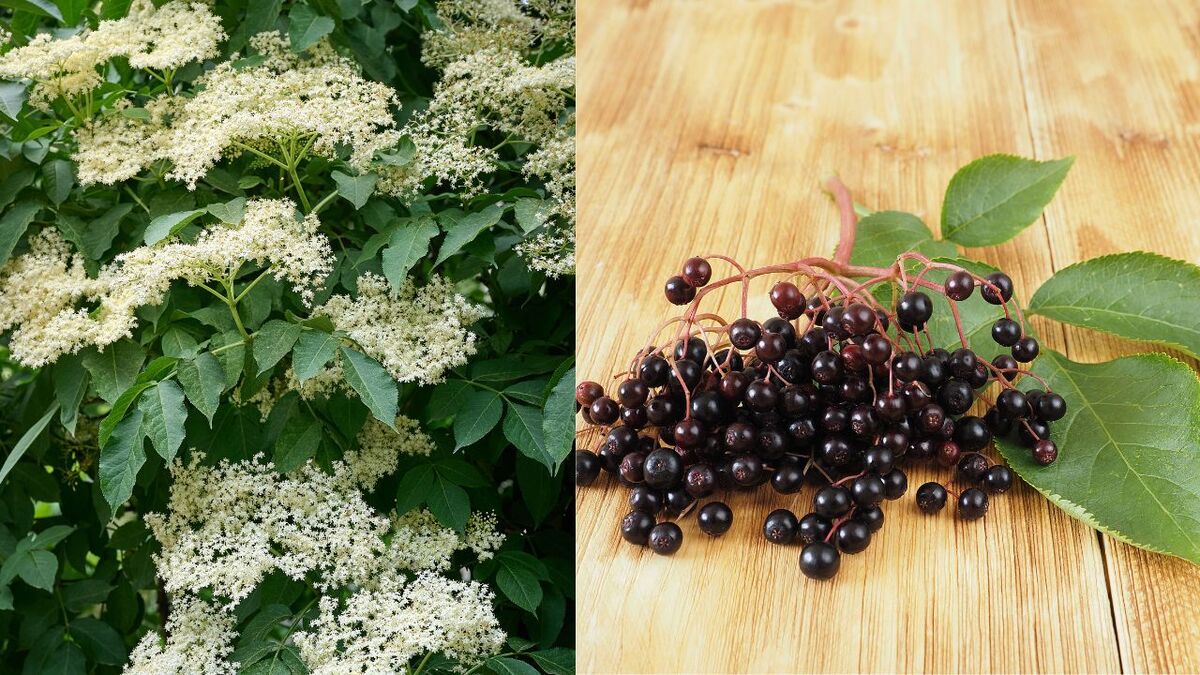
Red Elderberry (Sambucus racemosa)
Also woody, but:
- Brown pith instead of white
- Blooms earlier (April/May) with yellowish-white flowers
- Upright, cone-shaped flower panicles (not plate-shaped)
- Red berries in upright clusters
- Important: Seeds remain toxic even after cooking – always juice and strain!
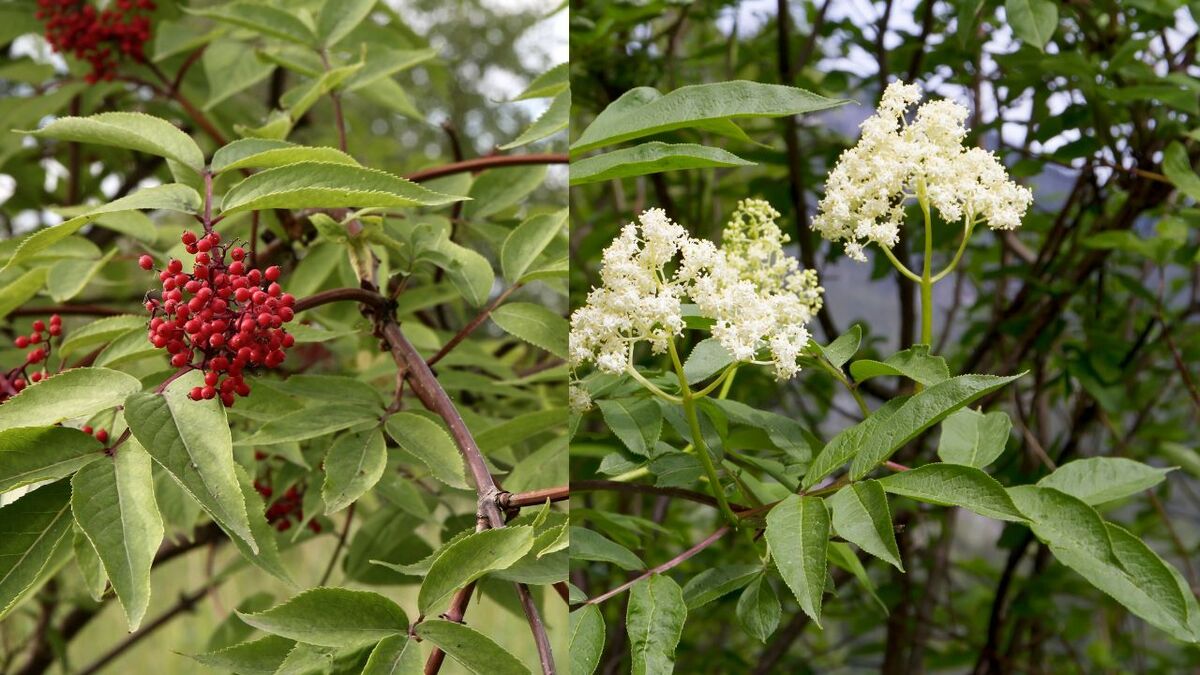
Dwarf Elder or Danewort (Sambucus ebulus)
This is the dangerous relative.
- Herbaceous perennial, not woody
- Dies back completely in winter
- 50–150 cm high
- Berry clusters stand upright, not drooping
- Red anthers (instead of yellow)
- Stinks when rubbed (hence "Stinkholder")
- Completely toxic, even after cooking
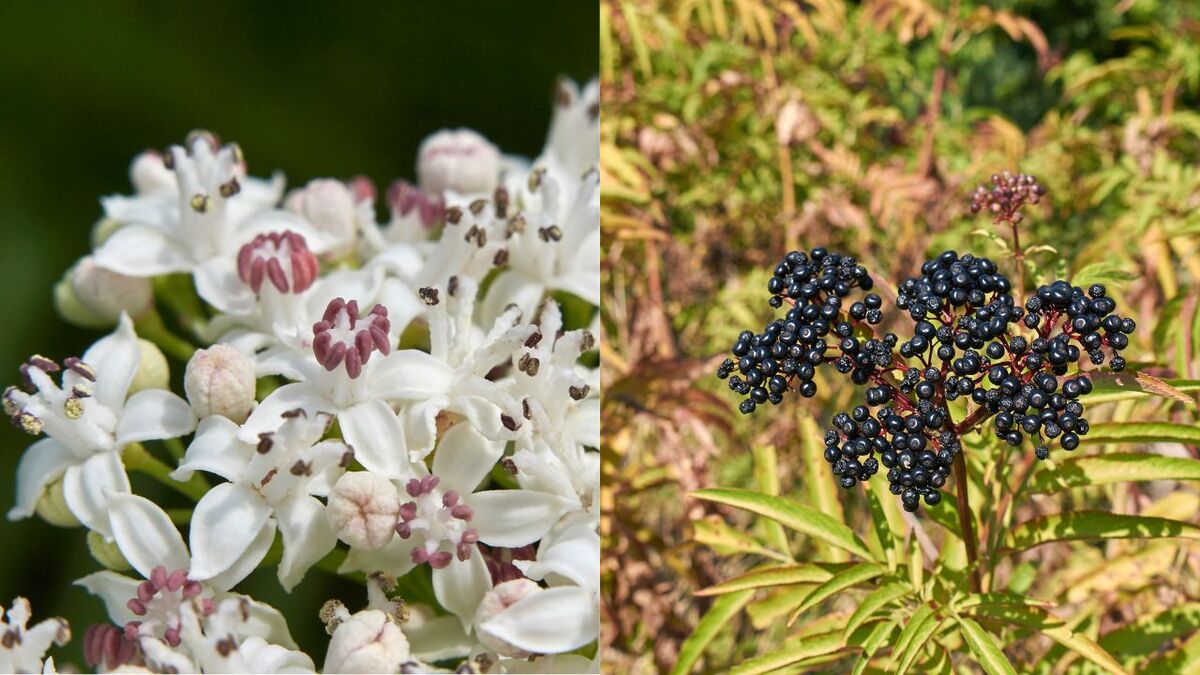
This confusion is not trivial. The Pflanzen-Vielfalt plant portrait lists the differences very clearly. Anyone traveling as a wilderness mentor with groups should be able to recognize the three species in their sleep.
👉 More on the risks of collecting wild plants in general: Collecting wild plants without risk
Why never eat berries raw?
All elderberry species contain sambunigrin – a cyanogenic glycoside. Prussic acid is released from it in the stomach.
The consequences: nausea, vomiting, abdominal cramps, diarrhea.
The solution: Sambunigrin decomposes starting at about 76 °C. Anyone who heats elderberries for at least 20 minutes at over 80 °C has safe food in front of them.
This heat rule is *the* most important elderberry lesson you pass on to children and beginners.
Elderberry as bushcraft material – the underestimated genius
Now it gets exciting.
Because the elder is not just food and a medicinal plant. It is one of the most versatile bushcraft materials we have in Central Europe.
The pith – a gift of nature
When you cut through an elderberry branch, you see it immediately: a large, foam-like pith channel in the middle.
This pith is worth its weight in gold.
As a fire booster: Dry pith from dead elderberry branches takes an ember immediately. I use it regularly when I need to light a fire in damp weather (dry charcoal also works great). Lars Konarek describes this technique in his post on lighting material and tinder very vividly.
As charred pith: If you char the pith in a metal tin under exclusion of air (just like with Char Cloth), you get a reactive spark catcher for flint and steel. Try it out – it works excellently.
👉 More on the topic in general: Collecting and making tinder yourself (20+ examples)
The friction fire with elderberry spindle
Elderberry wood – especially that from one-year-old, dried shoots – is a great material for the hand drill and also for the Bow Drill.
Why does it work so well?
Anatomy. A hard, lignin-rich outer shell encloses a soft, cellulose-rich pith. During drilling, the friction quickly creates hot wood dust, and the pith acts as an additional, easily flammable substrate.
I like to combine the elderberry spindle with a hearth board made of linden, poplar, or willow. This combination – harder spindle on soft board – maximizes the abrasion of the board material. And that's exactly what you need for ember formation.
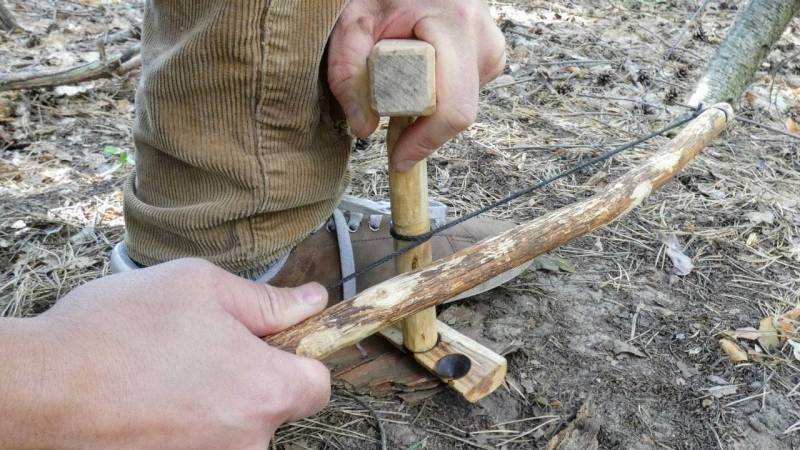
👉 More background on wood selection: Which wood for the friction fire
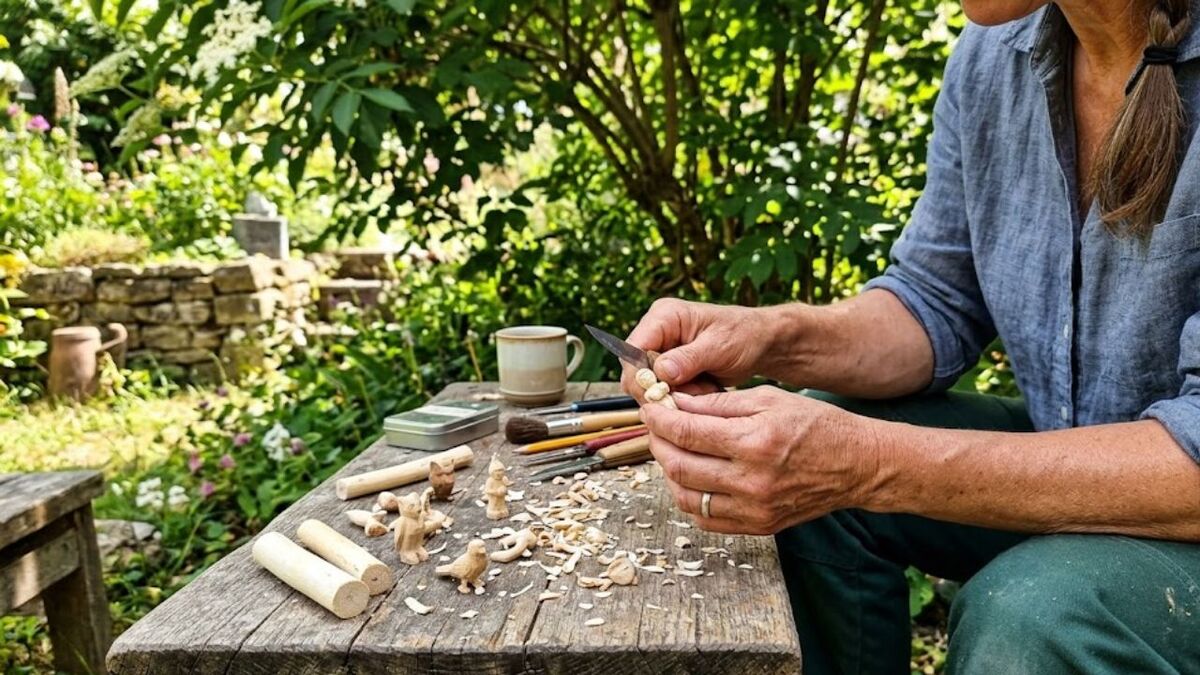
Whistles, flutes, and blowguns
The pith can be easily pushed out with a wire or a thin stick – ideally when fresh, because it solidifies when drying.
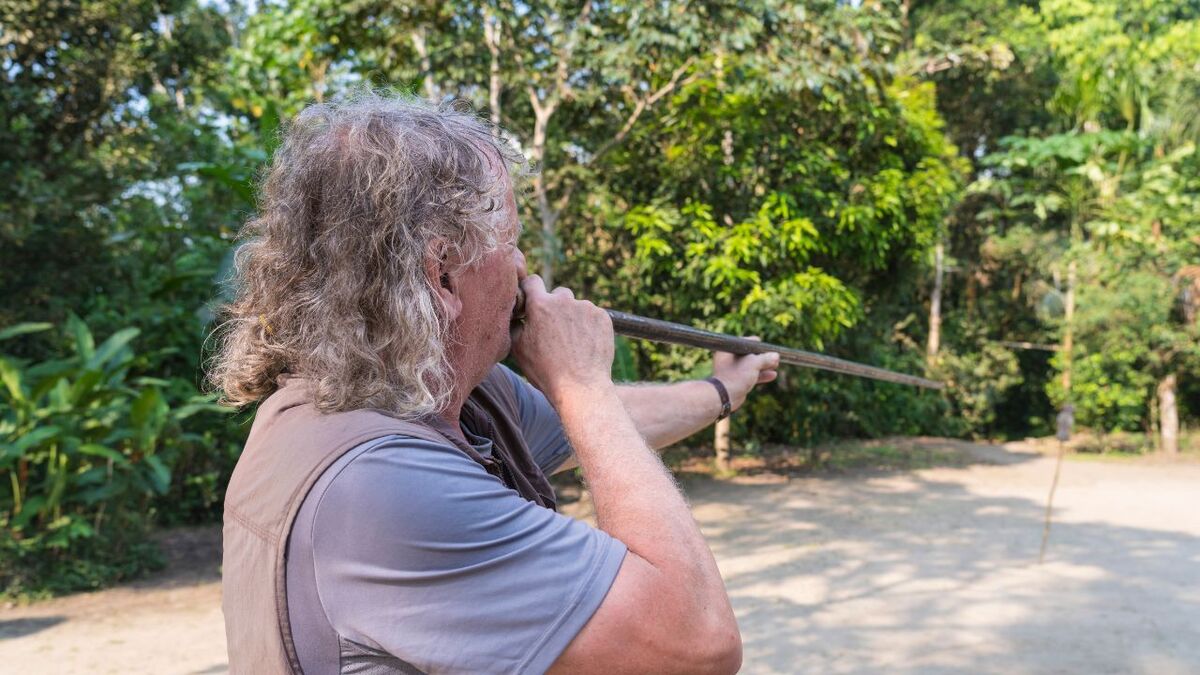
What remains: a perfect wooden tube for flutes or blowguns.
The oldest archaeological find of a Central European wooden flute is, by the way, made of elderberry – the fragment comes from the pile dwelling settlement of Hagnau on Lake Constance.
Elderberry whistles were the toys of children and the instruments of shepherds for thousands of years. The Greek name sambyke already referred in antiquity to a harp-like instrument that was supposedly made of elderberry wood.
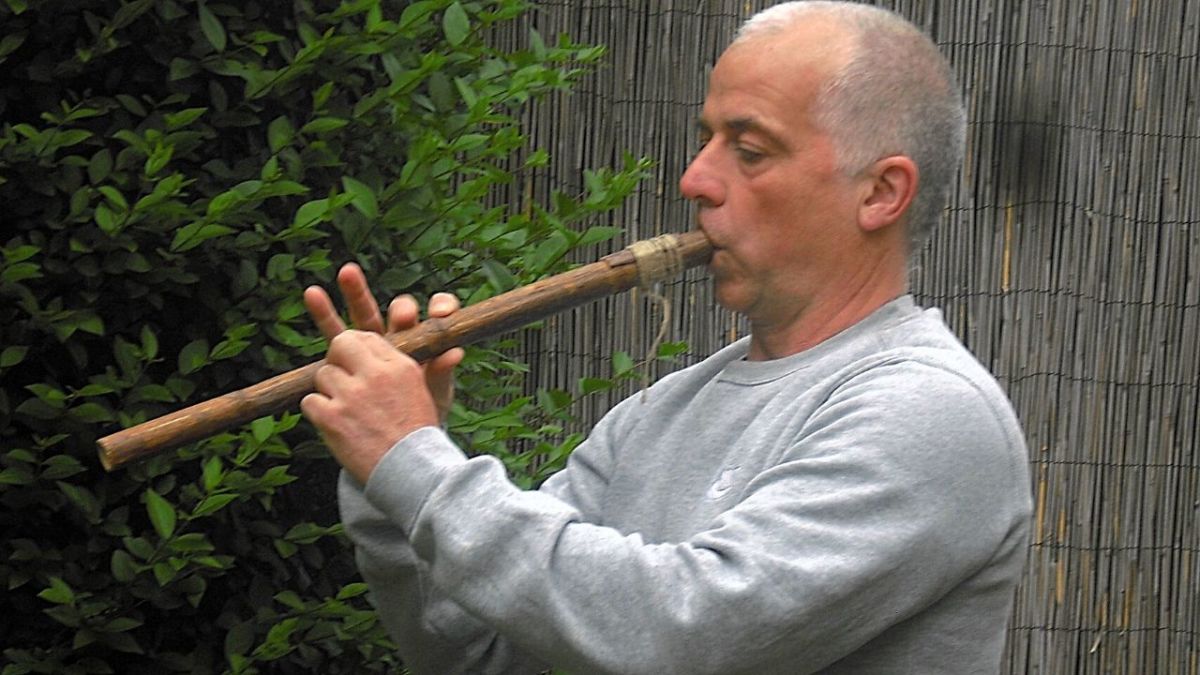
Elderberry Whistle Construction Guide (simplified):
- Cut a straight, finger-thick branch (approx. 15–20 cm)
- Push out the pith with wire
- Make a vertical 5 mm cut about 2 cm from the mouth end
- Make a second diagonal cut → a small labium is created
- Carve a block from other wood that seals the mouth area
- Insert the block up to the labium
- Blow in – done
A wonderful activity for wilderness courses with children. Their eyes get big when an inconspicuous branch suddenly becomes a real instrument. Read more here about flute building from Japanese knotweed.
The fire blow-pipe
Here comes my personal favorite for every campfire.
A longer elderberry branch (60–80 cm) with hollowed-out pith becomes a blow-pipe. You place the mouth end to your lips and the other end on the embers – and can specifically direct air onto individual ember points without singeing your eyebrows.
An "extension of the lungs," as it's called in bushcraft.
If you don't have a metal or plastic blow-pipe effect with you: elderberry is the answer.
Elderberry in nature crafts – the pith as a specialized tool
Who would have thought that the pith of the elderberry is one of the hidden stars of scientific history?
👉 In microscopy, elderberry pith was used as a standard embedding material in the 19th and early 20th centuries. The Mikroskopie-Forum has discussed this in detail. For razor-thin plant sections – stems, petioles, fine structures – the object was clamped between two halves of pith, and clean cuts could then be made with a razor without the material being crushed.
👉 In watchmaking, elderberry pith is still used today to clean fine bearings and to store oilers.
👉 In physics, small elderberry pith balls served as pendulums for electroscopes for over two centuries. Anyone who had physics as a student in the 1980s might have still worked with them.
Dyeing with elderberry – its own little universe
The deep violet-red color of the berries has fascinated people for thousands of years.
The anthocyanins in the berries react differently depending on the pH value:
- In an acidic environment (vinegar, citric acid) → pink-red to violet
- In a basic environment (soda, ash) → blue-violet to gray
- With iron mordant → deep black-brown
In the Middle Ages, elderberry ink was produced in scriptoria. And yes – in the 19th century, it was also used to "improve" (i.e., color) wine, which was not infrequently illegal.
Today, the anthocyanin is approved as a food colorant under the E-number E163. If you see a violet gummy bear variety – chances are high that elderberry is in it.
If you want to dye yourself: watch out for lightfastness. Elderberry colors fade relatively quickly in the sun. Wool and silk take the colors better than cotton. A mordant with alum is standard.
Mythology – why our ancestors revered the elderberry
"One must tip one's hat to the elderberry."
Hardly anyone knows the proverb today. But until the early 20th century, this was a matter of course in many rural regions of Central Europe.
Mother Hulda and the sacred shrub
The elderberry was considered the sacred tree of Holda – the Germanic earth and mother goddess, who became "Mother Huldae" in fairy tales. She was responsible for fertility, birth, death, spinning, weaving, and the weather.
When Mother Hulda shakes out her beds, it snows.
And where did Mother Hulda live? In every elderberry bush that stood at a farmstead.
In the Scandinavian region, she is called Hyldemoer – the "Elder Mother." The old rule: before you cut a branch from the elderberry, you must ask her for permission:
"Mother Hulda, give me some of yours, then I'll give you some of mine!"
Protection and threat in one
The elderberry at the farmstead was considered:
- Protection against lightning
- Protection against fire
- Protection against evil spirits
- Protection against witches
- Protection against diseases
At the same time, it was also a warning: anyone who felled an elderberry or willfully damaged it brought misfortune into the house. Some traditions even speak of death in the family circle.
"Elderberry withers → death in the house." This connection was described so simply – and so impressively.
The Celtic layer
For the Celts, the elderberry was a threshold tree – a tree between the worlds. It stood for death and rebirth because it is apparently dead in winter and sprouts again in spring.
In the Celtic tree calendar (according to Robert Graves), the elder corresponds to the month from November 25 to December 22 – the darkest time of the year. Exactly when everything sinks into death and waits for the new light.
Harry Potter and the Elder Wand
If you are traveling with children or teenagers: the Elder Wand from Harry Potter – the most powerful wand in the world – is made of elderberry wood.
J.K. Rowling plays with the English superstition "Wand of elder, never prosper" – and skillfully uses the double meaning of *elder*: the plant and someone older.
This bridge often opens the door to mythology for young participants. Suddenly, the elderberry behind the farmhouse is no longer just a shrub, but a living piece of European history.
What the elderberry in the forest tells you about history
Here comes something I particularly love.
The elderberry is a nitrogen indicator. It grows where the soil is particularly nutrient-rich – i.e., where a lot of manure, urine, or organic material was stored.
That means practically:
If you come across an old, free-standing elderberry bush in the forest or at the edge of the forest that apparently grows in the middle of nowhere – then there was almost certainly a farmstead, a stable, a dunghill, or a hut there in the past.
Elderberry is a settlement marker.
I have found such elderberry bushes in the forest several times with groups – and while searching around them, I actually discovered dilapidated wall remains or old well foundations.
That makes the elderberry a perfect tool for nature mapping and place-based learning. Let your participants mark elderberry bushes in the forest – and you have a living history map.
The healing side – brief and factual
I don't want to write a plant portrait here, so I'll summarize it compactly:
👉 Elderflowers are effective as a recognized medicinal drug for early colds – diaphoretic, secretolytic, mildly antiviral. Classic elderflower tea as a hot sweat cure has been tested for centuries.
👉 Elderberries contain massive amounts of anthocyanins with proven antiviral effects. Studies on Sambucol have shown in several small clinical trials that elderberry extract can shorten the duration of illness in influenza. NHV Theophrastus has chosen the Black Elderberry as the Medicinal Plant of the Year 2024.
The old saying about the "farmer's pharmacy" had its reason.
Practical ideas for your wilderness courses
Here are a few exercises that I use regularly myself:
Building elderberry whistles with children: A classic that always works. Plan enough time – children are usually unstoppable afterwards.
Charring pith at the campfire: Excellent exercise on the topic of pyrolysis. With the aha-effect that a valuable spark catcher is created at the end.
Three-species test in the field: Let your participants learn to distinguish between Black, Red, and (if present) Dwarf Elder. With the "stand-up" question: "Which one would kill you?"
Preparing elderflower syrup together: Works even in a day course. The participants take a jar home with them.
Mother Hulda stories at the campfire: Storytelling in the best sense. Works for children *and* adults.
Elderberry as a settlement marker in the forest: A hike with the task of finding old elderberry bushes and searching for traces of human use.
👉 More inspiration for the outdoors: 41 bushcraft ideas with children
Collecting and harvesting – what you should consider
When collecting in Germany, the "hand-bouquet rule" applies (§ 39 Federal Nature Conservation Act): for personal use, you may harvest small quantities of wild-growing plants – as long as you are not in a nature reserve and the owner (in the case of private property) does not object.
Urban elderberry is usually safer than expected. A study by the TU Berlin has shown that elderberries in urban areas can accumulate heavy metals – but even 10–20 meters distance from the main road or a shielding hedge significantly reduces the load. More on this at mundraub.org.
What I would never harvest:
- On railway embankments (herbicides)
- On busy roads
- On industrial wasteland
- Directly next to sprayed fields
Ethics when collecting: Over 60 bird species feed on elderberries. Leave at least half standing. The shrub behind the farmhouse doesn't have to be completely harvested.
What you can do this week
Go out.
Look for an elderberry. In the garden, at the edge of the woods, at an old farmstead. Or in the middle of the city – on a wasteland, at the railway embankment (to look at, not to harvest).
Look at it. Really.
Carefully break off a small branch. Look at the pith. Inhale the smell.
And then – if you like – say quietly:
"Mother Hulda, give me some of yours, then I'll give you some of mine."
You don't have to be spiritual to find that beautiful.
But you can understand that our ancestors lived in a world where every shrub had a story. A relationship. A name.
We cannot bring this world back.
But we can experience it again for a second.
And then – at the next wilderness course, at the next family excursion, at the next encounter with children – you can pass this second on.
The elderberry is waiting. It has time.
It has already waited for our grandparents. And for their grandparents.
When I think of my old elderberry behind my grandparents' garden shed, then I know: it's probably still standing there today.
Mother Hulda has staying power.

Sources for the guide
- Holunder - Roter-Holunder - Bestimmung (schwach GIFTIG), Zugriff am Mai 2, 2026, https://www.pflanzen-vielfalt.net/baeume-straeucher-a-z/baeume-uebersicht-a-k/holunder-roter-holunder/
- Der Traubenholunder – Ein ökologisch wertvoller Pionier - Waldwissen.net, Zugriff am Mai 2, 2026, https://www.waldwissen.net/de/lebensraum-wald/baeume-und-waldpflanzen/laubbaeume/der-traubenholunder
- So erkennst du Holunder sicher - COCO GRÜN, Zugriff am Mai 2, 2026, https://coco-gruen.de/holunder/
- Wildobst im Raum Berlin-Brandenburg zwischen Ökonomie und Ökologie: Forschungsgegenstand, Nischenprodukt, Trendsetter oder Naturschutzobjekt? - Sanddorn eV, Zugriff am Mai 2, 2026, https://www.sanddorn.net/BA-15-07-2014.pdf
- Der Hausbaum: Schwarzer Holunder (Sambucus nigra) | Naturschutzinitiative e.V., Zugriff am Mai 2, 2026, https://naturschutz-initiative.de/newsletterbeitrag/der-hausbaum-schwarzer-holunder-sambucus-nigra/
- Holundermark - Mikro-Forum, Zugriff am Mai 2, 2026, https://www.mikroskopie-forum.de/index.php?topic=857.0
- Roter und Schwarzer Holunder - Unterschiede beim Austrieb - Natur-Tagebuch, Zugriff am Mai 2, 2026, https://natur-tagebuch.ch/roter-und-schwarzer-holunder-unterschiede-beim-austrieb/
- Feuer bohren #4 Holunder auf Weide - YouTube, Zugriff am Mai 2, 2026, https://www.youtube.com/watch?v=4Y797sI8HyA
- Handdrill, Hand Feuerbohren, Hölzer/Sträucher - Bushcraft-Germany, Zugriff am Mai 2, 2026, https://bushcraft-germany.com/index.php?thread/1792-handdrill-hand-feuerbohren-h%C3%B6lzer-str%C3%A4ucher/
- Nutze diese Holzart für den Feuerbohrer und du hast einen kritischen Punkt verbessert, Zugriff am Mai 2, 2026, https://www.youtube.com/shorts/K3Gt0jvQbbg
- Feuer machen mit Anzündmaterial, Zunder und Holz - Lars Konarek, Zugriff am Mai 2, 2026, https://www.larskonarek.de/post/feuer-machen-mit-anz%C3%BCndmaterial-zunder-und-holz
- GobSpark Armageddon Firesteel in the field - YouTube, Zugriff am Mai 2, 2026, https://www.youtube.com/watch?v=KbIJ8J_udcQ
- Flint And Steel Fire Without Char - Testing Materials - Burnt Wood - YouTube, Zugriff am Mai 2, 2026, https://www.youtube.com/watch?v=f-6M-BpBDvQ
- Holundermännchen selber machen - Lernen im Garten, Zugriff am Mai 2, 2026, https://www.lernenimgarten.at/methode/holundermaennchen-selber-machen
- Holundermark für Pflanzenschnitte - Mikro-Forum, Zugriff am Mai 2, 2026, https://www.mikroskopie-forum.de/index.php?topic=200.0
- Holunder - Schwarzer-Holunder - Bestimmung (schwach GIFTIG), Zugriff am Mai 2, 2026, https://www.pflanzen-vielfalt.net/baeume-straeucher-a-z/baeume-uebersicht-a-k/holunder-schwarzer-holunder/
- Alles rund um Färbungen mit Holunderbeeren - Seite 4 - Spinnradclub - Forum, Zugriff am Mai 2, 2026, https://www.scforum.spinnradclub.de/viewtopic.php?t=20967&start=45
- Färben mit Naturfarbstoffen - Projektarbeiten am Institut Dr. Flad, Zugriff am Mai 2, 2026, https://www.chf.de/eduthek/projektarbeit-faerben-mit-naturfarbstoffen.html
- Über Naturfarben, Färben mit Naturfarbstoffen und Färberpflanzen in der Stadtnatur von Kristin Hensel - Urbane Gärten, Zugriff am Mai 2, 2026, https://urbane-gaerten.de/images/PraxiswissenSelbstbauten/Praesentation_Webinar_%20Farben%20der%20Natur.pdf
- färberpflanzen: farbergebnisse mit bildern & grundrezept - Sehestedter Naturfarben, Zugriff am Mai 2, 2026, https://www.sehestedter-naturfarben.de/blog/rezepte/faerberpflanzen-farbergebnisse-mit-bildern-grundrezept
- Kleidung färben mit Pflanzenfarben: Nachhaltige DIY-Ideen mit Naturfarben, Zugriff am Mai 2, 2026, https://www.umweltberatung.at/textilien-faerben
- Holunderbeerenfärbung - 5.,6., 7. und 8. Farbzug - lavendelblau, Zugriff am Mai 2, 2026, http://lavendelblau.blogspot.com/2010/10/holunderbeeren.html
- Wolle selber färben - Anleitungen & Methoden - Talu.de, Zugriff am Mai 2, 2026, https://www.talu.de/wolle-selber-faerben/
- Experiment Solarfärben – Die Kraft der Natur - Verdrehte Masche, Zugriff am Mai 2, 2026, https://www.verdrehtemasche.de/experiment-solarfaerben-die-kraft-der-natur/
- Blumen pflücken: verboten oder erlaubt? - NABU, Zugriff am Mai 2, 2026, https://www.nabu.de/tiere-und-pflanzen/pflanzen/pflanzen-schuetzen/blumen-pfluecken.html
- Handstraußregel - wie viel darf man in der Natur ernten - Samenhaus Gartenblog, Zugriff am Mai 2, 2026, https://www.samenhaus.de/gartenblog/handstraussregel-wie-viel-darf-man-in-der-natur-ernten
- Ist Straßenobst mit Schadstoffen belastet? | mundraub.org, Zugriff am Mai 2, 2026, https://mundraub.org/blog/stra%C3%9Fenobst-wenig-belastet
- Wie gesund ist die Essbare Stadt - Mundraub, Zugriff am Mai 2, 2026, https://mundraub.org/sites/default/files/inline-files/Studie_Schadstoffbelastung.pdf

Author of the guide
Martin Gebhardt
Hey, I'm Martin. On my blog, you will learn the basics and numerous details about living in the wild. I think survival, bushcraft and the good life in nature are the keys to happiness. Find me here on Instagram or on YouTube. You can find more about my mission on the About Me page.
Was this guide helpful?
12 people found this guide helpful.
5.00 out of 5 points (12 Ratings)
Comments (0)
This post may contain affiliate links. So if you click on the links and make a purchase, I will receive a small commission at no additional cost to you. Click here, to learn more about it.